


BY ALLISON POTTERMAN
Ronald Ingram is an AI engineer, bank owner, and founder working where banking, health, and intelligent agents meet. He shipped his first AI systems more than twenty years ago. In the early 2000s he coined the term “Neobank” and later wrote NEOBANK: Navigating the Future of Banking. His career has been spent building real financial infrastructure, not decks: privacy, security, self-sovereignty, and tools people can actually use.
That work now lives in Neobanx and BROK, an AI super-robo-genius private banker that went live July 24. Neobanx is building a global agentic banking system: banking for people and for machines working alongside them. BROK sits at the center, with $POCK for agentic commerce and core banking technology aimed at long-horizon resilience. The mission is straightforward. Put genius-level tools for wealth and health in more hands, from boardrooms to kitchen tables, and build in public with real users.
BROK did not start as a consumer toy. It was designed for bankers. Ingram likes to joke that bankers need more time on the golf course and less time writing credit memos and perfecting security agreements. He built to make that work simpler and faster. The punchline surprised even him: he made banking so easy a kid could do it.
That was the turn. If the hard parts of banking could be automated and explained at genius level, the same system could serve not only institutions but anyone who transacts, which is literally everyone, anywhere in the world. Neobanx became the company to carry that path forward in public, starting with a private banker that fits in your pocket and turns deep insight into simple, executable next steps.
Privacy is a product feature, not a slogan. Genius-level help should not force users into a black box they cannot question. That is why BROK is paired with tools meant to level the playing field. One is IEM-based decision support: explainable evaluation so recommendations can be inspected, not just accepted. Another is Neoscore, a patented, longer-horizon approach to credit-style judgment as a global alternative to old, centralized, black-box scoring systems. Convenience still matters: plain language, free credits to try, real-time interaction, and self-sovereign patterns where the product allows them, with clear human oversight.
Building BROK was a live forge, not a clean lab project. The ambition was larger than a chatbot wrapper: banking rails, wealth and health tools, explainable decisions, and a community that would actually use it, shipped as a Zero Person Enterprise in months rather than years. Real-world inputs are messy. Ingram’s process leans into that: stream-of-consciousness capture, then hard operations like structure, reframe, and clarify, then stress tests with critique, opposing views, risks, and mitigations. When models thrashed, the team cut ambiguity and ran again. Truth and quadrivalent logic (true, false, both, neither) were design constraints so BROK would not invent certainty. Progress is measured in FTEP, Full-Time Equivalent Person power: a plain metric for how much human-scale work the machine stack is really doing.
Unexpected lessons rewrote the product. Audience expanded from bankers to everyone. Intelligence without explanation failed trust, so explainability stayed non-negotiable. Community feedback became part of the roadmap. Shipping in public exposed gaps faster than private perfectionism.
Looking five years out, Ingram sees BROK moving from a powerful pocket private banker toward everyday infrastructure for agentic banking. Near term means deeper wealth and health guidance, stronger explainable tools, and fairer access patterns. Trading research is part of the horizon, with eyes open. The team has seen a wide gap between AI trading promises and real results, and has also found legitimate edges. Where law allows, those may be offered carefully and legally. As a bank owner, Ingram’s bar is above and beyond the letter of the law on risk. The same research may go public under a working title, Truth on Trading: free research to reduce harm and cut through scams, with signals charged where appropriate. BROK’s prime directive is asset protection as well as wealth creation for each user and for the community: protect first, create wealth second, speak truth.
If people tell one story about Ingram and Neobanx, he hopes it is this: he made banking intelligence real, and kept control with the user. Not another hype machine. A live product, built in the open, serious enough for banking and simple enough for anyone who transacts.
On Saturday, August 15 at Tech Alley, fully animated, speech-enabled BROK will introduce Ronald Ingram on the big screen for Q&A, with free credits and access for attendees. Readers can learn more at neobanx.com and brok.neobanx.com, follow the build on X at @RonaldIngram, and watch long-form demos on YouTube as that channel grows. Neobanx is building the global agentic banking system in public. BROK is how more people get genius-level help without surrendering control.
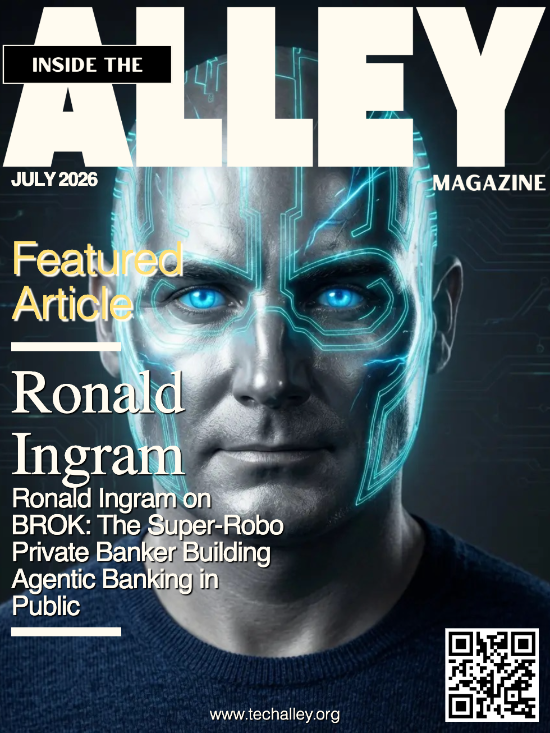
Featured Interview
Ronald Ingram on BROK: The Super-Robo Private Banker Building Agentic Banking in Public
Article Type
FEATURING Ronald Ingram
Below is our interview with Ronald Ingram.
{Introduction}
Tell us about Neobanx, and what inspired you to launch the business?
Neobanx is Ronald Ingram’s path to a long-held goal: global, equal, fair access to banking in an age of intelligent agents.
BROK did not start as a consumer toy. It was designed for bankers. Ingram likes to joke that bankers need more time on the golf course and less time writing credit memos and perfecting security agreements. So he built tools to make core banking work radically simpler and faster. The punchline surprised even him: he made banking so easy a kid could do it.
That was the turn. If the hard parts of banking could be automated and explained at genius level, then the same system could serve not only institutions but anyone who transacts, which is literally everyone, anywhere in the world. Neobanx became the company to build that path in public: a global agentic banking system, starting with BROK, a super-robo-genius private banker that fits in your pocket and turns deep insight into simple, executable next steps on wealth and health.
Around BROK sit $POCK for agentic commerce and core banking technology aimed at privacy, security, self-sovereignty, and community. BROK went live July 24. The vision is not hype for its own sake. It is real product, real users, and a fairer on-ramp to banking intelligence for boardrooms and kitchen tables alike.
How does Neobanx ensure privacy without compromising user convenience?
Neobanx treats privacy as a product feature, not a slogan. The goal is genius-level help without forcing users into a black box they cannot question.
That is why BROK is paired with tools meant to level the playing field. One is IEM-based decision support: explainable evaluation so recommendations can be inspected, not just accepted. Another is Neoscore, a patented, longer-horizon approach to credit-style judgment as a global alternative to old, centralized, black-box scoring systems. Together they are infrastructure for fairer access: wealth and banking intelligence that more people can actually use and understand.
Convenience still matters. BROK is designed as a super-robo-genius private banker in your pocket: plain language, executable next steps, free credits to try, real-time interaction. Privacy and control stay design goals alongside speed, through self-sovereign patterns where the product allows them and clear human oversight.
Ingram’s larger frame is the singularity economy: banking that can absorb AI, crypto, and quantum-era pressure without abandoning ordinary people. Neobanx’ bet is that sophisticated tools only count if they stay simple enough for anyone who transacts, which is everyone.
What challenges did you face while developing BROK?
Building BROK was less a clean lab project and more a live forge. The first challenge was ambition itself: not a chatbot wrapper, but a real private-banker agent tied to banking rails, wealth and health tools, explainable decision support, and a community that would actually use it. Shipping that as a Zero Person Enterprise, in public, in months rather than years, forced brutal prioritization.
The second challenge was the AI itself. Long, messy, real-world inputs break models. Ingram’s process leans into that: stream-of-consciousness capture, then hard operations like structure, reframe, and clarify, then stress tests with critique, opposing views, risks, and mitigations. When the system thrashed, the team did not romance the failure. They cut ambiguity, sharpened the key message, and ran again. Truth and quadrivalent logic, holding true, false, both, and neither without inventing facts, were design constraints so BROK would not paper over uncertainty with hallucination.
The third challenge was product trust. Banking tools cannot be black boxes. That pushed explainable IEM-style evaluation, Neoscore as a longer-horizon alternative to opaque credit orthodoxy, privacy and self-sovereignty as features, and a user experience simple enough that convenience did not require surrendering control.
They measure progress in FTEP, Full-Time Equivalent Person power: a plain metric for how much human-scale work the machine stack is really doing. The result went live July 24. The hard part was never only code. It was building something sophisticated enough for the singularity economy and simple enough for anyone who transacts.
What unexpected lessons did you learn that shaped BROK’s final product?
Several lessons showed up only in the build, and they rewrote the product.
The first was audience. BROK was designed for bankers: less time on credit memos and security agreements, more time on judgment and relationships. The unexpected outcome was radical simplicity. When banking work became easy enough that a kid could follow it, Ingram saw the real destination: not only institutional efficiency, but global, fair access for anyone who transacts.
The second was that intelligence without explanation fails trust. Users will not hand wealth and health decisions to a black box. That pushed explainable IEM-style decision support and Neoscore as a longer-horizon alternative to opaque, centralized credit orthodoxy. Sophistication had to stay inspectable.
The third was process. Messy human input is not a bug. Stream-of-consciousness capture, then hard ops (structure, reframe, clarify), then critique and risk stress tests, produced better results than cosplay “act as an expert” prompting. When models thrashed, the lesson was to cut ambiguity, not to add theater. Truth and quadrivalent logic (true, false, both, neither) kept the system from inventing certainty.
The fourth was measurement. Feature lists impress decks. FTEP, Full-Time Equivalent Person power, forces an honest question: how much real human-scale work is the stack doing? That metric shaped prioritization as much as any roadmap slide.
Finally, community is part of the product. Building in public, with free access paths and real users, exposed gaps faster than private perfectionism. BROK’s live form is the compound of those lessons: a pocket private banker for boardrooms and kitchen tables, serious enough for banking, simple enough for everyone.
How do you foresee BROK evolving in the next five years?
Over the next five years Ingram sees BROK moving from a powerful private banker in your pocket to everyday infrastructure for a global agentic banking system, with wealth, health, and careful trading intelligence under one truth-seeking agent.
Near term, the focus stays on depth people can feel: stronger wealth and health guidance, explainable IEM-style decisions, Neoscore as a fair alternative to black-box credit orthodoxy, and privacy, security, and self-sovereignty without making the product hard to use. Community feedback remains a core steering input.
Trading is part of that roadmap, with eyes open. In research, Neobanx found a large gap between what AI trading culture promises and what it actually delivers in profits and expectations. The team has also uncovered legitimate edges and opportunities. Where law allows, BROK is intended to make those available in the appropriate legal way, jurisdiction by jurisdiction. As a bank owner, Ingram’s standard is above and beyond the letter of the law on risk management: no hype that outruns compliance, suitability, or asset protection.
That same research may go public to protect people from scams. A working title is Truth on Trading: publish the findings so the community can see signal versus theater. The model under consideration is simple: research free, signals charged. BROK’s prime directive is asset protection as well as wealth creation for each user who engages, and for the community. Reducing harm and exposing fraud early improves prosperity for all. Not mainly through more laws and regulation, but through truth.
Mid horizon, BROK should power more Zero Person Enterprises and agentic commerce via $POCK, with output measured in FTEP, Full-Time Equivalent Person power. Longer term, the bet is banking that can absorb AI, crypto, and quantum-era shock while still serving ordinary people, from boardrooms to kitchen tables. BROK does not need to win every hype cycle. It needs to stay useful, careful, and honest: protect first, create wealth second, and tell the truth about what works.
What story do you want people to tell when they talk about you and your business?
Ingram hopes people tell a simple story: he made banking intelligence real, and kept control with the user.
Not that he built another hype machine. That he took decades of AI and banking work, put a super-robo-genius private banker in ordinary people’s pockets, and aimed it at fair access: wealth and health tools for boardrooms and kitchen tables, with privacy, security, and self-sovereignty as core values. That BROK started as a gift to bankers and became a path for anyone who transacts. That the company ships in public, measures real leverage in FTEP, and cares as much about asset protection and truth as about upside, including honest research on trading so people are harder to scam.
If the story ends with one line, he would like it to be this: Neobanx is building the global agentic banking system in the open, and BROK is how more people get genius-level help without surrendering control.
Readers can learn more at neobanx.com and brok.neobanx.com, follow the build on X at @RonaldIngram, and watch long-form demos and talks on YouTube at https://www.youtube.com/@Ronald_Ingram. Where events allow, they can meet Ingram and live BROK in person, including Tech Alley on August 15.


About
MoreArticles

{Title}
{Author}